
Clinical-Stage · Maternal-Fetal Medicine
Redefining Outcomes
in Early-Onset Preeclampsia
A first-in-class, fetal-sparing complement therapeutic built to change the trajectory of early-onset preeclampsia.
Clinical-Stage · Maternal-Fetal Medicine
A first-in-class, fetal-sparing complement therapeutic built to change the trajectory of early-onset preeclampsia.
Nesya targets the “Why” of early-onset preeclampsia, upstream complement activation, rather than the “What” of downstream sFlt-1/PlGF imbalance. One disciplined program, built to answer a decisive clinical question.
The Problem
Early-onset preeclampsia (EOPEC) is a severe, fast-progressing maternal-fetal disease. Today the sole definitive intervention is delivering the placenta, which, before term, means a premature baby.
Maternal organ injury, hypertension, and seizure risk can escalate within hours, an inpatient, high-acuity emergency.
Management is monitoring, blood-pressure control, and timing delivery. Nothing modifies the underlying disease.
Ending the pregnancy “treats” the mother but delivers a premature infant into the NICU, trading one harm for another.
Source: DelveInsight, diagnosed preeclampsia prevalence across the 7MM, 2024.
The Science
Complement, an immune pathway triggered by placental debris, initiates and amplifies early-onset preeclampsia. Rare inherited C5 and C6 variants that track with the disease support it as a likely driver, not just a correlation.
Driven by fetoplacental debris
Inflammation & ischemia
Angiogenic imbalance
EOPEC manifestations
The Solution
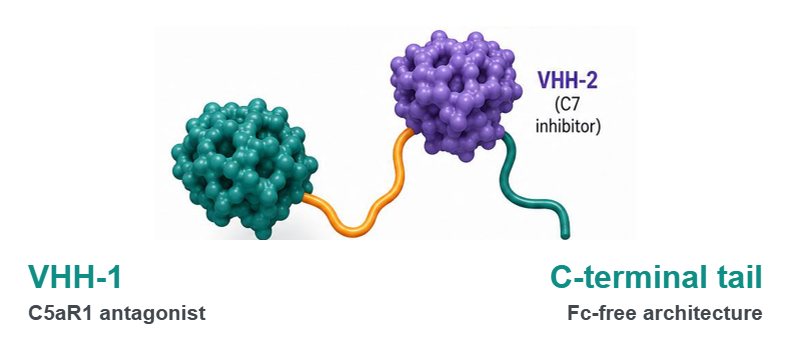
Designed to remain on the maternal side of the interface. Standard antibodies carry a kind of “passport”, the Fc region, that lets them cross the placenta. Elaranen is built Fc-free, intended to minimize placental transfer and keep activity on the mother’s side.
No Fc domain means no FcRn-mediated transport across the placenta, the property that lets antibodies reach the fetus.
Intended to act on the maternal side and minimize fetal exposure, a central objective the program is designed to demonstrate.
Eculizumab is known to cross the placenta. Elaranen’s bispecific VHH (C5aR1 + C7) architecture is designed to avoid that.
Why Now
The science, the capital, and the technology have arrived, and the upstream complement lane has no dedicated clinical entrant.
Rare C5 / C6 variants track with preeclampsia risk and severity.
Comanche’s oversubscribed $75M Series B proves investors back disease-modifying PE drugs.
Modern nanobody engineering enables maternally-restricted, fetal-sparing designs.
Every competitor is downstream; the upstream lane has no dedicated clinical entrant.
The Team

A practicing maternal-fetal medicine specialist with direct EOPEC clinical experience, who designed Nesya’s complement strategy from clinical first principles.

Operational and capital-formation expertise, responsible for execution and company building, turning a defined asset into a financeable, IND-directed program.
Why Us
No team is better positioned to run the decisive complement test in EOPEC: clinical origin, a real human signal, and a defined, translation-ready asset.
A founder-physician who has managed early-onset preeclampsia at the bedside.
Documented complement-blockade cases motivate the controlled test we are built to run.
Deep grounding in the upstream biology every competitor leaves unclaimed.
Not a concept: a FASTA-locked, owned bispecific VHH ready to advance.
A defined path to human placental-perfusion rescue, the strongest pre-trial signal.

Nesya is executing the decisive clinical test. For investment, partnership, or media inquiries, get in touch.
Prefer email? Reach us directly, or open your mail app. We reply to every serious inquiry.
We've received your inquiry and will reply within two business days at the email you provided.